Destroyer Squadron 56 World War II Operations
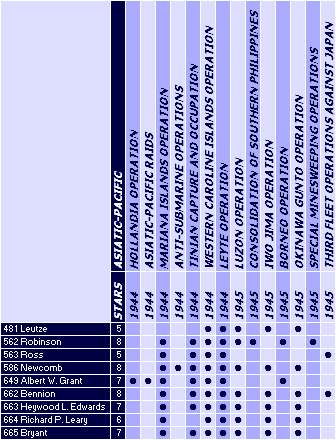
Destroyer Squadron 56
Mid 1944
Destroyer Division 111
USS Leutze (DD 482)
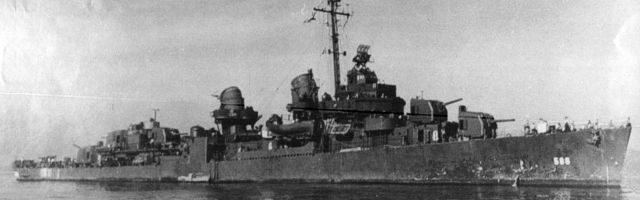
USS Newcomb (DD 586), flag
USS Bennion (DD 662)
USS Heywood L. Edwards (DD 663)
USS Richard P. Leary (DD 664)
Destroyer Division 112
USS Robinson (DD 562)
USS Ross (DD 563)
USS Albert W. Grant (DD 649)
USS Bryant (DD 665)
DesRon 56 was one of three squadrons of 2,100-ton
Fletcher-class destroyers that joined the Pacific war in time for the Marianas operation in 1944. It consisted of nine square-bridge ships commissioned between November 1943 and March 1944—
Newcomb (DD 586, flagship),
Bennion (DD 662),
Heywood L. Edwards (DD 663) and
Richard P. Leary (DD 664) from
Boston Navy Yard;
Albert W. Grant (DD 649) and
Bryant (DD 665) from
Charleston Navy Yard;
Robinson, (DD 562) and
Ross (DD 563) from
Seattle-Tacoma Shipbuilding and
Leutze (DD 481) from
Puget Sound Navy Yard.
OPERATIONS
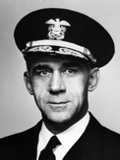
Capt. Roland N. Smoot, USN, Commodore, DesRon 56 in 1944. Photo as Rear Admiral. NARA photo 80-G-433302; source: Naval History & Heritage Command.
“The torpedo attacks in this battle [of Surigao Strait] were some of the best of the Pacific war. Captain Smoot pressed his attack admirably close, which is the main reason why his squadron was the only one to suffer.”
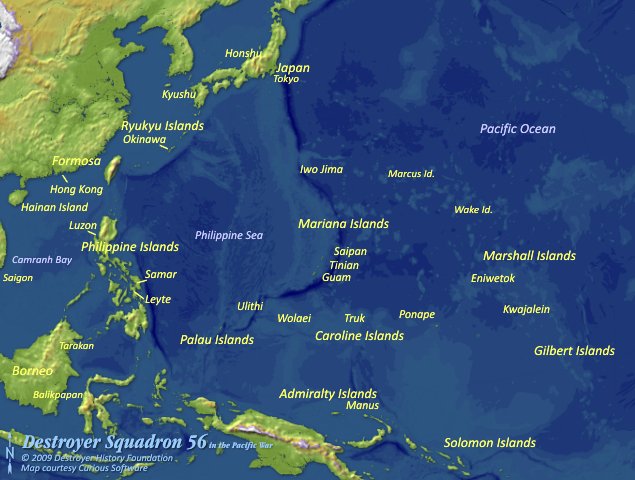
All except Leutze served at Guam, Saipan and Tinian. The squadron was fully formed for the following invasion of the Palau Islands before moving on to the Philippines.
Destroyer Squadron 56
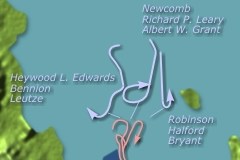
Battle of Surigao Strait
Section 1
USS Newcomb (DD 586), flag
USS Richard P. Leary (DD 664)
USS Albert W. Grant (DD 649)
Section 2
USS Robinson (DD 563)
USS Halford (DD 480)
USS Bryant (DD 665)
Section 3
USS Heywood L. Edwards (DD 663)
USS Bennion (DD 662)
USS Leutze (DD 482)
On 19 October 1944, while preparing for the Leyte landings, Ross sustained two mine explosions off Homonhon Island at the entrance to Leyte Gulf. She was replaced for the Leyte operation by DesRon 45’s Halford (DD 480, Leutze’s sister ship from Puget Sound, which had been commissioned April 1943 and initially fitted with an experimental seaplane catapult, removed that November).
Under Capt. Roland N. Smoot, these nine ships attacked in three sections at the Battle of Surigao Strait, 24–25 October 1944. Several ships timed one or more torpedo hits on Japanese flagship Yamashiro, which sank soon thereafter. In retiring, Grant was disabled by as many as 22 enemy and friendly hits, then towed clear from alongside by Newcomb.
In 1945, Robinson and—after repairs—Grant were transferred to Seventh Fleet, with which they operated through the invasion of Borneo, during which Robinson served as flagship of DesRon 22. The other seven ships remained together for the invasion of Luzon.
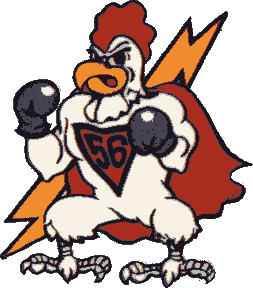
“Bantam Six,” the squadron’s call sign, gave rise to a stack emblem drawn by
Newcomb’s Robert Boyle that all ships carried—a bantam rooster with boxing gloves, spoiling for a fight.
In February 1945, Halford was sent home for repairs when her bow was damaged in collision, after which she was assigned to other squadrons. This left six ships (Newcomb, Leutze, Bennion, Edwards, Leary and Bryant) operating together for the invasions of Iwo Jima and Okinawa.
LOSSES
On 6 April 1945 off Ie Shima, a seven-plane suicide attack disabled
Newcomb and
Leutze. (The squadron commander transferred his flag to
Richard P. Leary.)
Newcomb was towed home while
Leutze made it back on one screw, but both were scrapped after the war. One week later, an attacking plane hit
Bryant in the bridge, putting her out of the war as well.
Grant,
Leary and
Halford ended the war in Alaska.
DECORATIONS
Especially in light of their squadron’s short service, the collective record of the original ships was a distinguished one, with decorations that included four individual Navy Unit Commendations (
Newcomb,
Grant,
Bryant and
Edwards), two additional recommendations (
Leutze and
Leary) and one Presidential Unit Citation (
Bennion).