
Scarcely had American forces consolidated their positions on Guadalcanal after the successful landing of 7 August 1942, when the Japanese indicated their resolve to regain control of the southern Solomons. Although they made no immediate effort to capitalize on their success in the Battle of Savo Island on the night of 8-9 August, strong forces appeared in the vicinity of the Santa Cruz Islands on 24 August. These forces included three and possibly four carriers. They withdrew after a violent attack by our carrier planes in the Battle of the Eastern Solomons, 23-25 August, which cost them the carrier Ryujo.1
For a time after this Japanese defeat, surface actions were confined to minor clashes, chiefly at night, between light destroyer and torpedo boat units.2 Japanese surface forces attempting to land additional troops and matériel in the Cape Esperance area were continually harassed by planes from Henderson Field.
By mid-October, however, the Solomons had become for both the American and Japanese navies a magnet attracting increasingly large fleet units. The two great battles which assured the United States at least temporary control of the South Pacific were still distant 2 weeks and a month respectively, but they were clearly imminent. Neither side felt able to dominate the southern Solomons with the forces then on Guadalcanal; neither had marshalled sufficient strength to challenge the other to a full-size engagement; yet both were determined to fight, and by the end of the first week in October both were ready to risk their heaviest naval units.
During the latter part of September and early October, the Japanese were concentrating surface units in the Shortlands area, and sending them
--1--south toward Guadalcanal--through the inside passage between New Georgia, Choiseul and Santa Isabel Islands--so as to reach the northwest tip of Guadalcanal, Cape Esperance, at night. These ships would debark reinforcements, or bombard our Henderson Field positions, and retire by daybreak.
To consider means of halting these reinforcements and raids, which increasingly threatened our Solomons positions, a conference was called at Espiritu Santo. Our available surface forces in the South Pacific were few, and plans for the heaviest of them had already been laid. A large convoy with Army reinforcements for Guadalcanal was soon to depart from Noumea. By 11 October it would be about 250 miles west of Espiritu Santo. Task Force KING,3 which included the aircraft carrier Hornet, was to support the convoy to the westward. Protection to the east was to come from a battleship-cruiser force, built around the Washington, which was expected to assume a position east of Malaita.
ORGANIZATION OF OUR FORCE
Based at Espiritu Santo, however, was Task Force SUGAR, commanded by Rear Admiral Norman Scott, and organized as follows:
2 heavy cruisers:
San Francisco, (F), Capt. Charles H. McMorris
Salt Lake City, Capt. Ernest G. Small1 light cruiser:
Boise, Capt. Edward J. Moran
3 destroyers, Capt. Robert G. Tobin
The Task Force as thus constituted was too small for effective operations against the enemy units likely to be encountered. It was augumented therefore by three other ships operating in the vicinity of Espiritu Santo: the light cruiser Helena (Capt. Gilbert C. Hoover), and the destroyers Duncan (Lt. Comdr. Ennis W. Taylor) and McCalla (Lt. Comdr. William G. Cooper).
If dispatched within the next few days, this force would, when off the southern shore of Guadalcanal, exert a protective influence on the left
--2--
flank of the Army convoy moving toward that island, even though not connected with the convoy in an operational sense.4 Since its creation as a separate unit on 20 September, it had engaged only in target practice.
Accordingly, Task Force SUGAR was ordered to sortie from Espiritu Santo on 7 October, and steam to a point in the neighborhood of Rennell Island, from which, upon receipt of air search information that enemy units were moving towards Guadalcanal, it would proceed to the Savo Island area in time to intercept them. Its stated mission was to "search for and destroy enemy ships and landing craft."
ADMIRAL SCOTT'S INSTRUCTIONS
Task Force SUGAR's operational plans were contained in a memorandum issued by Admiral Scott on 9 October, 2 days out of Espiritu Santo.
Provided the horizon was visible, each cruiser was to launch two planes to scout the shore line of Guadalcanal for enemy landing operations, and offshore for supporting forces. The aircraft were to endeavor to maintain contact with the enemy until the approach of the Task Force, then to drop bombs and float-lights to indicate the enemy's position. Planes were to report any information regarding the enemy, even though negative. Flares were not to be used unless expressly ordered by Admiral Scott. Upon the completion of their mission, or in the event that tactical scouting was impossible, the planes were to proceed to Tulagi, fuel at daybreak, and report their readiness to Admiral Scott via the commanding general on Guadalcanal, who would inform them of the point for a rendezvous with Task Force SUGAR. Radio was to be used for essential messages.
Concerning the formation of his surface ships, Admiral Scott specified that the cruisers were to "form DOG,"5 in order to facilitate signals, with the destroyers divided two ahead and two astern of the cruisers. The destroyers were instructed to illuminate targets as soon as possible after radar contacts, to fire torpedoes at large ships and direct shell fire at enemy destroyers and small craft. The heavy cruisers were to use continuous fire against small ships at short range, rather than full gun salvos with long intervals. The third and fourth cruisers in the column (the
--3--
Salt Lake City and the Helena) were, with the destroyers, to keep watch on the disengaged flank, and to open fire without orders from Admiral Scott.
The van destroyers were cautioned to observe changes of course by the cruisers should TBS6 fail, and to be alert for turn signals by TBS or blinker. They were specifically warned to keep the TBS adequately manned and the circuit as clear as possible. Emphasizing that Japanese gunfire would quickly follow searchlight illumination, Admiral Scott advised the use of counter-illumination and opening of fire without delay, He added that the danger of silhouetting one's own ship should be borne in mind.
Blinker tubes were to be dimmed, and to show blue or red lights; white lights were to be used only when necessary. TBS silence was to be maintained as long as feasible, although all ships were authorized to use TBS to report contacts.
Ships compelled to fall out of formation should do so on the disengaged flank, and proceed towards Tulagi if unable to make 15 knots. If consistent with the task, a destroyer screen would be provided. All ships were to be ready to tow or be towed. A ship becoming separated from the formation was not to rejoin until after requesting permission, giving bearing of approach in voice code. In the event of failure to rejoin during the engagement, ships would proceed to an agreed 0800 rendezvous.
In conclusion, Admiral Scott stressed the importance of maintaining formation to facilitate identification. All ships were to be alert for challenges, and to show night fighting lights with discretion.
PRELIMINARY MOVEMENTS
Task Force SUGAR departed from Espiritu Santo late in the afternoon of 7 October. Its approach was uneventful, marked only by target practice on 8 October and brief antiaircraft practice that night. A position north of Rennell Island, just outside the range of enemy air search, was assumed the next day. At 11227 on the 10th the Helena and Duncan joined the formation, which became complete with the arrival of the McCalla the next day.8 On both the 9th and 10th, approaches were made,
--4--
as planned, to a 1600 position that permitted reaching the vicinity of Savo Island, at 20-25 knots, by 2300. However, air search revealed no suitable targets, and on both days the Task Force retired to the south of Rennell Island. Four planes from the force were flown to Tulagi on 10 October, to remain overnight and effect a rendezvous at 1600 on the 11th.
11 OCTOBER-EVENTS PRIOR TO ACTION
1347 Air search reports two enemy cruisers and six destroyers steaming towards Guadalcanal. 1400 Enemy air raid on Henderson Field delays return of Task Force SUGAR's planes. 1600 Approach to Savo Island begins. 1810 Air search again reports two enemy cruisers and six destroyers approaching Guadalcanal. 1815 Sunset; Condition of Readiness ONE is set. 2025 Course changed to 330° T. 2115 Course changed to 000° T. 2200 Cruisers launch 1 plane each. 2235 Battle disposition assumed on course 075° T. 2300 Course changed to 050° T. 2325 Helena's SG radar contacts enemy vessel bearing 315° T., distance 27,700 yards. 2326 Salt Lake City's SC radar contacts three enemy vessels bearing 273° T., distance 16,000 yards. 2335 Cruisers countermarch to 230° T. 2342 Helena and Boise report radar contacts by TBS. 2346 Helena requests permission to open fire. The morning of 11 October passed without incident and with no intimation that the day would be more eventful than the two which had preceded it.
At about 1345, however, search planes from Guadalcanal were reported by ComAirWing ONE as having sighted two enemy cruisers and six destroyers steaming at high speed on the accustomed Japanese route down "the slot" on course 120° T. bearing 305° T., at a point 210 miles from Guadalcanal. Estimating the situation, Admiral Scott concluded that to intercept the enemy, Task Force SUGAR should reach the Savo Island area about an hour before midnight. Meanwhile the force would proceed slowly to the 16009 position set for a rendezvous with the planes dis-
--5--
--6--patched to Tulagi the previous day. The OTC also doubtless hoped for further air search information about the enemy force.
However, the rendezvous and the more detailed information were delayed by a heavy Japanese air attack on Henderson Field during the afternoon of the 11th. Seventy-five planes attacked in four waves. Eight enemy bombers and four fighters were shot down, at a cost of two of our fighters. The Task Force's planes at Tulagi were unable to take off as scheduled, and the enemy attack restricted the activities of long-range search planes at Guadalcanal. No other Japanese surface forces were sighted during the 11th, and Admiral Scott entered the engagement under the impression that only two enemy cruisers and six destroyers were opposed to him. In reality, the enemy force appears to have been considerably larger. If it had not been for the Japanese air attack, the additional ships might well have been sighted by our search planes.
Despite the failure of the cruiser planes to effect the agreed rendezvous, Task Force SUGAR at 1600 departed at 29 knots from latitude 11°30' S., longitude 161°45' E., on course 320° T. The cruisers were in column, the San Francisco leading, followed by the Boise, Salt Lake City, and Helena. The cruiser column was screened by the destroyers in a 2,500 yard semicircle ahead, with the McCalla and Buchanan to port, the Farenholt dead ahead, and the Duncan and Laffey to starboard.10
At 1614 the cruisers each catapulted one plane to proceed to Tulagi, since it had been determined that each was to retain a single aircraft for search purposes on approach to the probable contact area.11 Between 1652 and 1709, however, the planes which had been flown to Tulagi the previous day finally appeared. It had been planned to send these aircraft back to Tulagi, but because of contaminated gasoline they were forced down in the immediate vicinity of our vessels. The Task Force immediately slowed to 10 knots, and the ships came right to render assistance. During the maneuver the San Francisco's plane hit the ship's side and was badly damaged. Admiral Scott was unwilling to lose the time required for salvage and ordered the Buchanan to recover the personnel and sink the plane. The Buchanan complied but did not regain her position in the formation until just after 2200, thus causing apprehension that she might not be available during the expected action.
--7--At 1810, ComAirWing ONE reported his search planes had again sighted two enemy cruisers and six destroyers on course 120° T., bearing 310° T., steaming at 20 knots some 110 miles from Guadalcanal. There was little doubt that it was the force originally reported. This second message reinforced the belief that no other enemy vessels were in the area.
Condition of Readiness ONE was set as the sun went down at 1815. The wind was 7 knots from 120° T., the sea calm, with moderate swells. There was a 1,000-foot ceiling of broken cumulo-nimbus clouds. Dusk gradually gave way to a dark night, permitting surface visibility of 4,000 to 5,000 yards The temperature was 81° F.
Half an hour later, a navigational fix obtained aboard the Salt Lake City established her position as latitude 10°42' S., longitude 160°14' E. At 2025 the course was changed to 330° T., and at 2145, when the Task Force passed through latitude 09°43' S., longitude 159°26' E., a further alteration was made to 000° T. Speed was reduced to 25 knots.
From sunset onward Task Force SUGAR's radars were as active as security considerations permitted. The San Francisco (F), lacked SG12 equipment. Admiral Scott had been informed that the frequency of the flagship's SC13 radar was similar to that with which Japanese apparatus operated. Hoping to achieve surprise, he ordered the San Francisco's SC not to be used during the evening. The flagship's FC radar14 was in use, although on a limited search sector. The Salt Lake City, Boise, and Helena, possessed excellent SG equipment, all of which was actively employed as contact with the enemy became probable. The Boise's SG was searching for enemy vessels continuously through 360°. So, presumably, were the SG's aboard the Salt Lake City and the Helena. The Salt Lake City's SC was searching sector 180° to 360° R, and her FC was covering sector 225° to 315° R. The Boise's FC had been assigned to sector 045° to 135° T.15
About 2200, with the enemy likely to be encountered in another hour, Admiral Scott ordered one aircraft launched from each cruiser. Immedi-
--8--ately after the Salt Lake City's plane was catapulted, flares in the after cockpit inexplicably ignited, setting the aircraft ablaze. It crashed in flames 500 yards from the ship, burned fiercely for 3 minutes, and sank. The pilot and observer made Guadalcanal in the plane's rubber boat. Task Force personnel were fearful that the fire had revealed the Force's position to the enemy.
Admiral Scott's order to the cruisers to launch their planes was never received by the Helena. But her commanding officer, Capt. Gilbert C. Hoover, was unwilling to incur the risk of keeping his plane aboard, and jettisoned it at 2214.
Just before 2230, as the Force neared the northwestern end of Guadalcanal, the course was changed to 075° T., in order to round the tip of the island as previously planned. A few minutes later, with the enemy expected within the half hour, battle disposition was assumed. The destroyers Farenhalt, Duncan, and Laffey formed column in the van, followed by the San Francisco, Boise, Salt Lake City, and Helena in column, with the Buchanan and McCalla in column in the rear.
After effecting the change of course, the Salt Lake City made final battle preparations, jettisoning six 600-pound depth charges, and one depth bomb, all without pistols. As the ships passed the tip of Guadalcanal on the starboard hand, several lights were noted on the island. The Salt Lake City observed a white light, never identified, about 14,000 yards distant. The Helena saw a light on the starboard beam. Capt. Robert G. Tobin, commanding the destroyers from the Farenholt, sighted two blue lights on the beach at the northwest end of GuadalcanaL They had the appearance of range lights, so oriented that they might have been intended as aids to an approaching surface force. All indications were that such a force was expected.
Shortly before 2300, the pilot of the San Francisco's plane reported sighting one large and two small vessels off the north beach of Guadalcanal, 16 miles from Savo Island. The message was not "well understood" on board the flagship, where a strong possibility was felt that the ships reported by the plane were friendly. Moreover, the night was very dark, and visibility from a plane was known to be extremely poor. Furthermore, even if taken at face value, the plane's message seemingly referred to a force other than that which Admiral Scott believed to be approaching. With two cruisers and six destroyers expected off Savo momentarily, one large and two small vessels were merely an appetizer.
--9--Ten minutes later Savo Island was uncomfortably close, and the course was changed to 050° T., which left the island to starboard. The formation steamed on, while each passing minute increased the curiosity as to the whereabouts of the larger enemy force. The San Francisco's FC radar was inadequate for long range search, but Admiral Scott had to rely on it for all information except that afforded the lookouts by the surface visibility of 4,000-5,000 yards. At 2330 the flagship's plane reported that the one large and two small vessels previously reported were 16 miles east of Savo Island, about 1 mile off the Guadalcanal beach.
Meanwhile, unknown to the flagship, radar activity aboard the cruisers following her was becoming significant. At 2325, the Helena's SG apparatus recorded an unmistakable surface vessel at bearing 315° T., range 27,700 yards.16 A minute later, the Salt Lake City's SG recorded three ships on bearing 273°, 16,000 yards distant, proceeding at about 20 knots on course 120° T.17
Neither of these contacts was reported to Admiral Scott, who was becoming increasingly concerned lest, by steaming too far north, the enemy be given an opportunity to pass unnoticed between Savo and Guadalcanal. On the other hand, the two cruisers and six destroyers might have decided not to move on Guadalcanal that night. By reversing his course, the OTC would at least be able to engage the three ships reported by the San Francisco's plane, and another sweep off the northern end of Guadalcanal would assure him of meeting the larger force if in fact it did appear.
At 2332, according to the reports of the Salt Lake City, Farenholt and McCalla,18 Admiral Scott transmitted the following TBS message to the Task Force: "This is CTF. Execute to follow: left to course 230." Thirty seconds later he ordered, again over TBS: "From CTF: execute." The four cruisers executed column left about, the San Francisco leading, followed by the Boise, Salt Lake City and Helena. The destroyers, however, delayed. Capt. Tobin ordered them "to slow as necessary to remain astern of the cruisers until it could be ascertained whether DD's which had been in the rear were following cruisers in formation, or had turned to take
--10--new van positions." When Capt. Tobin learned that the rear destroyers, the Buchanan and McCalla, had turned in the same water as the cruisers and were thus still in the rear, he ordered the former van destroyers, the Farenholt, Duncan and Laffey, to increase their speed and, advancing along the starboard flank of the cruiser column, to regain their positions in the van. Capt. Tobin was as unaware as Admiral Scott of the radar contacts aboard the Salt Lake City and Helena. As luck would have it, scarcely 10 minutes elapsed between the completion of the countermarch by the cruisers and their opening fire at 2346. The Farenholt, Duncan and Laffey were then almost directly in the line of fire.19
For a very few moments after turning south, Admiral Scott had no cause for concern other than uncertainty regarding the position of his destroyers. This period of calm was short-lived. Immediately after the turn, the Helena's SG radar picked up at least five enemy ships at 18,500 yards on bearing 315° T. At 2338, the Boise's SG recorded a group of objects bearing 295° T., about 14,000 yards distant.
Capt. Moran promptly directed the assistant navigator to make sure the objects were not land. A minute later Battery 1 received a report from Radar Plot locating five ships on bearing 065° R. (295° T.), only 13,300 yards away. "Action starboard," "Set Condition Afirm," and "Load" were immediately ordered by Capt. Moran. The enemy formation appeared thus on the Boise's radar screen:
ENEMY FORCE AS DISCLOSED BY BOISE SG RADAR
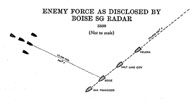
--11--Aboard the Boise, the location of Task Force SUGAR'S destroyers was known generally, but not precisely. Boise personnel were convinced there was no confusion at 2339 between the enemy's ships and ours.
At about 2342, the Helena reported via TBS to Admiral Scott a surface radar contact, bearing 298° T. The San Francisco's FC radar was ordered trained out of its previously assigned sector to pick up this target, and the Helena's report was transmitted to the task force.
When Capt. Tobin aboard the Farenholt--then abreast the cruiser column--received the message reporting the Helena's radar contact, he realized the predicament of the three van destroyers. He ordered the speed of the destroyers reduced, and considered the possibility of turning toward the cruisers in an attempt to take position astern of them.20
Admiral Scott also perceived the threat to the destroyers, and queried Capt. Tobin as to whether the destroyer squadron was coming ahead. Capt. Tobin replied affirmatively, saying he was coming up on the starboard flank. At that moment, 2342, the Helena reported another surface contact, on a target 12,000 yards distant at 285°. T.
A minute later the Boise reported the radar contacts as pictured on her screen, but the message referred to the objects as "bogies" and two bearings went out over TBS: 065° R. and 295° T. Only the San Francisco received both bearings; other ships in the Task Force received only the relative bearing, which they interpreted as true. Even aboard the San Francisco, however, there was doubt whether by "bogies" the Boise meant surface ships or aircraft, and whether, if surface ships, they were friendly or hostile. Lacking the visualization of the scene afforded by an SG radar screen, Admiral Scott feared the five objects reported by the Boise were his own destroyers. The San Francisco, in the van of the cruiser column, was separated by several thousand yards from the rear of the column. Admiral Scott did not know what course the five destroyers had taken after the cruiser countermarch. He did not know whether all five destroyers, or only the three which had formerly been in the van, were coming up on the right flank of the cruisers. All he did know was that from three to five destroyers were somewhere to the rear and to starboard of the San Francisco. The possibility that these five destroyers were the "bogies" reported by the Boise was alarmingly real. At 2344 he again asked Capt. Tobin whether the destroyer squadron was taking station
ahead. An affirmative answer, received just as the Helena again reported 5 ships (at 10,000 yards on bearing 276° T.), was scarcely reassuring.
Only from the limited viewpoint of Admiral Scott aboard the San Francisco are the circumstances in which he ordered "open fire" and "cease fire," understandable. Throughout the first phase of the battle, he could never know for sure that the cruisers following the San Francisco were not firing solely on our own destroyers.