


A Family Saga, a study by the late John L. Dickey, II, revised edition. Available from the Merriam Press.
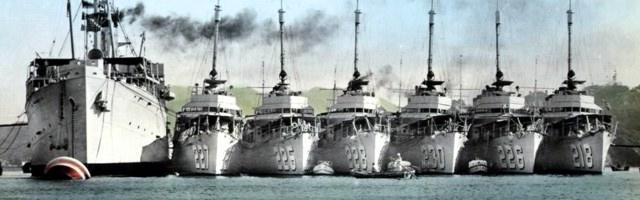
In 1916, there was a design change—to a new “flush-deck” hull with a continuous sheer strake. That summer, Congress passed the Naval Act of 1916, which authorized 50 more flush deckers as part of a build up intended to make the United States a major naval power. After the US joined World War I in April 1917, it increased this number to 273 to fight German U-boats.
There were three flush-deck classes: the Caldwell (6 ships) funded in 1916, and the nearly identical-looking Wickes (111 ships) and Clemson (156 ships) funded in 1917–18.
Eleven shipyards participated in the program, and while there were differences between builders and among individual ships, their standard displacement was 1,200 tons (±90) on an overall length of approximately 314 feet, a beam of approximately 31 feet and a mean draft of approximately 9 feet, 10 inches. With four boilers driving two 9-foot screws at 27,000 shp, they could make 33 knots. Their normal crew included 105 officers and enlisted men, and they were initially armed with four 4-inch deck guns, one 3-inch antiaircraft gun, twelve 21-inch diameter torpedo tubes and two stern-mounted depth charge tracks, plus 0.50 cal. machine guns and small arms.
Deliveries began slowly: Manley, the first flush decker, did not arrive until October 1917. By the time of the Armistice on 11 November 1918, only 41 had commissioned and only 27 had reached the war zone. Construction continued, however, until the program was complete in 1922. In July 1920, 14 were converted as light minelayers with their torpedo tubes removed.
Meanwhile, flush deckers made their way to many regions around the world:
On the evening of 8 September 1923, seven destroyers of DesRon 11—Delphy, S. P. Lee, Young, Woodbury, Nicholas, Fuller and Chauncey—were stranded on the California coast and lost in the US Navy’s worst-ever peacetime disaster.
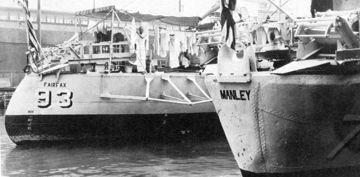
Fairfax (left) exhibits the canoe-style “cruiser” stern of the mass-production Wickes- and Clemson-class ships; Manley (right) exhibits the cutaway-type stern characteristic of the Caldwell class, which had been carried over from the preceding “flivvers” and 1,000-tonners.
1929 brought an unexpected discovery that “ . . . the material condition of the destroyers in active service indicates that those having Yarrow boilers (60 in commission) have reached the end of their useful life and must be replaced . . . .” With no funds available other than for normal maintenance and only 103 destroyers plus the destroyer-minelayers (six with Yarrow boilers) in commission, the entire burden of a rapid swap fell on the crews of these 60 ships. They turned to without delay, found that the laid-up ships were in good condition and, between January and June 1930, recommissioned 60 replacement ships from mothballs.
Fifty-six ships with Yarrow boilers were broken up in 1930–31. Three were expended as targets and two others, Preston (DD 327) and Bruce (DD 329), were expended in tests to determine how much strain their hulls could take. Results of these tests were applied in designing the Farragut class of 1932, the Navy’s first destroyers with longitudinal framing.
The arrival of the more powerful Farragut and other “goldplater” classes beginning in 1934, plus the 1930 London Naval Treaty—which defined maximum standard displacement for destroyers and also restricted total “completed tonnage . . . which is not to be exceeded on 31 December 1936”—prompted the scrapping of 35 more flush-deckers in 1935–37. Also in 1936, Smith Thompson was scuttled off Subic Bay, Philippine Islands after Whipple rammed her, reducing the total to 170.
Flush-deckers were prominent in the early events of US involvement in the war:
With or without alterations, few flush-deckers remaining in the US Navy still had four stacks when their service ended, as one or two of their four boilers normally were removed to increase range or provide additional accommodation, yielding two- or three-stack ships.
Some Royal Navy ships lasted longer, including nine loaned to Russia which operated with their own powerplants as late as 1952.
A few also continued in commercial service. The last of these was apparently the former Putnam, one of the four Yarrow-boilered ships stricken in 1930 and not broken up but sold and converted as diesel-powered banana carriers. As Teapa, she went to the Alaska Defense Command as a training ship during the war, then returned to the banana trade until 1950. She was sold to a breaker in 1955.
“With the passing of Teapa,” wrote Commander John D. Alden in his excellent 1965 book Flush Decks & Four Pipes, “the saga of the flush deckers apparently came to an end, but perhaps even now one survives as a barge or hulk in some backwater. But deep in their hearts, old destroyermen know that somewhere in the wide reaches of the oceans, one of their number still carries on, and when the truth becomes known, she will be seen in full fighting regalia escorting the Flying Dutchman into port when he completes his endless seafaring rounds on Judgment Day.”